The Real History of Buffalo Plaid
Buffalo plaid is one of the few patterns you can identify from across a parking lot. Two colors, one grid, no ambiguity. It's been on hunting coats, flannel shirts, dog beds, and diner tablecloths for the better part of two centuries, and it has never once looked dated. That's rare for a textile pattern. Most trends have a shelf life. Buffalo plaid has a history.

Where the Name Actually Comes From
The pattern predates the name by a long way. Checked wool weaves - even-spaced blocks of two alternating colors - go back to Scottish textile traditions, carried to North America by immigrant mill workers in the 18th and 19th centuries. What we now call "buffalo plaid" got its specific name and its signature red-and-black colorway from Woolrich Woolen Mills in Pennsylvania, generally credited to around 1850.

The story most often told: a Woolrich designer named the pattern after his own herd of buffalo, which is why the check took on "buffalo" rather than the more generic "check" or "tartan." Whether that detail is exactly true or slightly embellished by a century and a half of retelling, the outcome is the same - the pattern stuck, the name stuck, and by the late 1800s "buffalo plaid" was already shorthand for a very specific kind of American wool.

A Pattern Built for the Woods, Not the Runway
Buffalo plaid didn't start as fashion. It started as workwear for people who needed to be seen. Loggers, hunters, and trappers in the American Northeast and upper Midwest wore it because the high-contrast block pattern was easy to spot at a distance - useful in dense timber and eventually a genuine safety consideration once hunting seasons overlapped with logging operations. Red and black wasn't chosen for how it looked in a catalog. It was chosen because it was hard to miss.

By the early 20th century, the pattern had attached itself to a whole mythology of frontier labor - Paul Bunyan is usually pictured in it, whether or not that's historically accurate - and it settled into the wardrobe of anyone doing outdoor work through a cold season: rail workers, farmers, hunters, and eventually anyone who just liked the look of honest wool.

From Frontier Staple to Heritage Icon
What's kept buffalo plaid relevant for 170-odd years isn't nostalgia. It's that the pattern does something genuinely useful: it reads as substantial without trying hard. A block check in heavyweight wool signals durability the way a logo never can. Heritage outdoor brands built entire identities around it through the 20th century, and it's never fully left circulation since - it just moves between "everyday flannel" and "runway reference" every few years, always coming back to the same mills and the same two-color logic it started with.

The tonal shift matters too. Classic red-and-black is the loudest, most recognizable version - the one that started it all. But the same block-check logic done in charcoal and black reads entirely differently: quieter, easier to layer under a jacket, closer to workwear than to costume. Same pattern, same history, different register.

Why We Built The Lodge Collection Around It
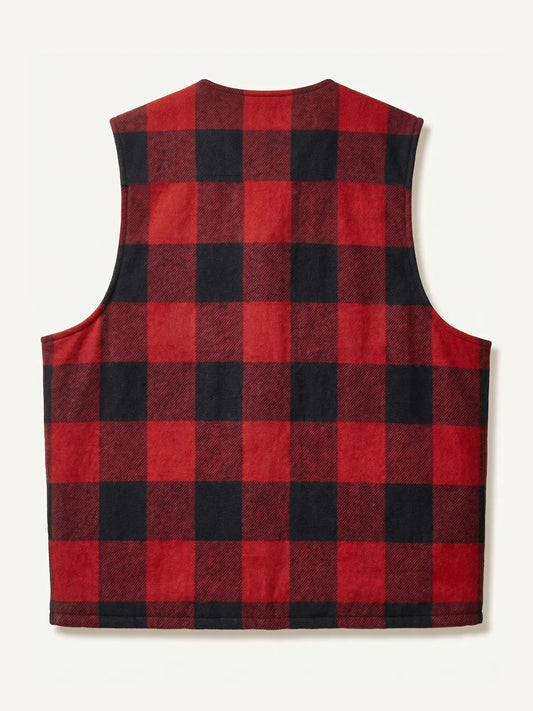
We didn't reach for buffalo plaid because it's trending. We reached for it because it's one of the few patterns with enough weight - historically and visually - to carry a heavyweight piece without needing anything else to make the case. That's the whole design brief behind The Lodge Vest in Red / Black Plaid: the classic colorway, cut in a clean V-neck silhouette with no collar, closed with a hidden magnetic system - magnets set in the interlining behind the buttons, so the front closes on contact and opens with a single pull. Nothing visible on either face, nothing to align by hand.

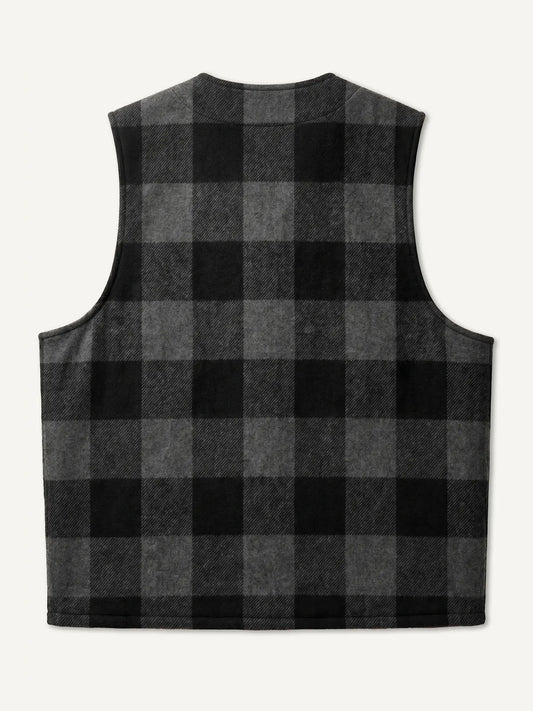
The same construction shows up in a quieter register in The Lodge Vest in Charcoal / Black Plaid - identical cut, identical closure, the contrast simply turned down. Charcoal against black instead of red against black, built for layering under a jacket rather than standing out in front of one. Same history, different volume.

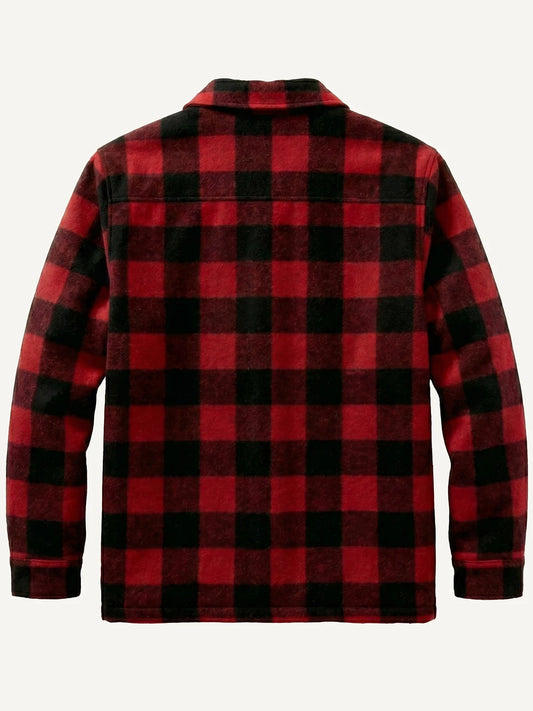
For a heavier piece built for colder mornings, The Lodge Jacket in Red / Black Plaid takes the same check into a full jacket with a structured point collar and four-pocket layout, closed with a magnetic zipper. The hardest part of any jacket zip has never been pulling it shut - it's threading the pin into the base while holding both sides steady with cold fingers. Magnets built into the pin and the box find each other on contact, and from there it zips exactly like an ordinary zipper. The shell itself is a vegan wool blend, brushed to the weight and hand of Mackinaw wool without asking anything of an animal to get there.

None of these three pieces ask you to think about the closure. That's the point of building it in rather than bolting it on - the same reason the pattern itself has outlasted a dozen fashion cycles. Good workwear doesn't announce itself. It just works, morning after morning, for as long as the wool holds up.
Explore the full Lodge collection, or read more on how we build the magnetic closure series and how we build the magnetic zipper series.